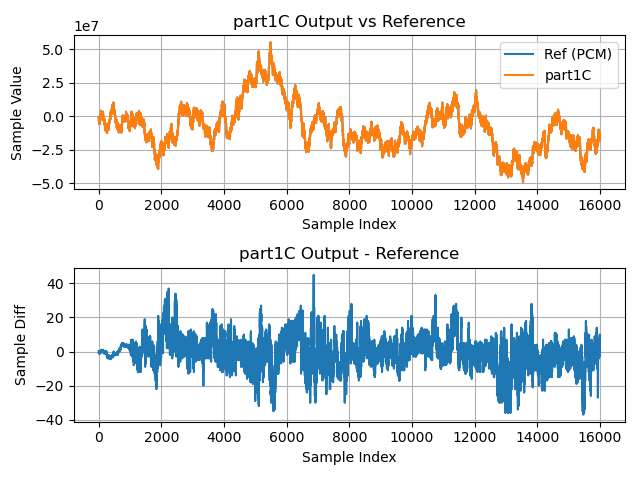
第1C部分:单精度浮点FIR滤波器,引入向量操作
与第1B部分类似,第1C部分使用单精度浮点运算来实现FIR滤波器。然而,与直接使用普通的C循环实现内积不同,第1C部分调用了lib_xcore_math提供的库函数vect_f32_dot()。
vect_f32_dot()函数是手动优化的XS3汇编代码,旨在尽可能快地执行。我们期望在这里看到另一个显著的性能提升。
这种加速的主要原因之一是,C编译器默认情况下不会生成C函数的双发(dual-issue)实现。双发代码通常允许内部循环大大缩短,但通常以程序大小为代价。
使用 lib_xcore_math 加速
本阶段使用了lib_xcore_math中的以下操作:
vect_f32_dot()
C_API
float vect_f32_dot(
    const float b[],
    const float c[],
    const unsigned length);
vect_f32_dot()函数接受两个float向量 b[] 和 c[](每个向量都有length个元素),将它们逐元素相乘,然后将乘积求和。其结果应与第1B部分中的filter_sample()的C实现相同,只是速度更快。
实现
第1C部分与第1B部分在filter_task()、rx_frame()和tx_frame()的实现上完全相同。唯一的变化是filter_sample()的实现。
src/part1C/part1C.c
//Apply the filter to produce a single output sample
float filter_sample(
    const float sample_history[TAP_COUNT])
{
  // Return the inner product of sample_history[] and filter_coef[]
  return vect_f32_dot(&sample_history[0],
                      &filter_coef[0],
                      TAP_COUNT);
}
与第1B部分通过循环遍历滤波器系数来实现filter_sample()不同,第1C部分直接调用了lib_xcore_math中的vect_f32_dot()函数。
结果
运行时间
| 时间类型 | 测量时间 |
|---|---|
| 每个滤波器系数 | 21.13 ns |
| 每个输出样本 | 21641.67 ns |
| 每个帧 | 5608909.00 ns |
输出波形